Set at the edge of the Amazon rainforest, the 30th United Nations Climate Change Conference (COP30), held in Belém, Brazil, symbolised both the urgency and the opportunity in climate action. With record-breaking temperatures and climate disasters affecting millions worldwide, the world entered COP30 with an acute understanding that the next decade must be one of implementation rather than aspiration.
COP30 focused on two interconnected pillars: advancing the implementation of the first Global Stocktake (GST) and formalising the Just Transition Work Programme (JTWP). These outcomes signalled an increasingly coordinated approach to climate governance, one that emphasises not only reducing emissions but also ensuring that the shift toward a greener future is fair, inclusive, and people-centred. For a climate-vulnerable, rapidly developing country like Viet Nam, the results of COP30 provide both valuable guidance and new responsibilities.
Strengthening Global Mitigation Efforts
One of the core achievements of COP30 was the strengthening of the Mitigation Work Programme (MWP), established to help countries raise their ambition in reducing greenhouse gas emissions. Delegates recognised that despite many pledges, current global mitigation efforts remain insufficient to keep temperature rise within the 1.5°C threshold. In response, COP30 introduced new dialogue platforms intended to support deeper and more practical cooperation.
The Veredas Dialogue emerged as a key initiative. It was designed to help countries explore the challenges and opportunities associated with implementing Article 2.1(c) of the Paris Agreement, aligning financial flows with climate goals. This platform seeks to translate high-level commitments into tangible actions by linking governments, financial institutions, and technical experts. Accompanying this was the launch of the Xingu Finance Talks, an annual high-level roundtable intended to encourage collaboration between policymakers and financial actors on mobilising investment for clean energy and resilience.
Taken together, these initiatives demonstrate a shift in the MWP’s direction. Rather than simply encouraging ambition, the programme now emphasises creating the enabling conditions (legal, financial, institutional, and technical) needed to turn ambition into measurable results. This shift is particularly important for developing countries whose ability to contribute to global mitigation depends significantly on access to finance and technology.
Global Stocktake: From Warning to Action
The first Global Stocktake since the adoption of the Paris Agreement delivered a stark message: global emissions are not declining, leaving the world on course for a temperature rise of 2.3°C to 2.8°C by the end of the century. Acknowledging this wide gap between commitments and reality, COP30 launched two implementation-oriented initiatives.
The Global Implementation Accelerator (GIA) aims to help countries translate their NDCs into concrete actions by providing technical support and facilitating knowledge exchange. Complementing this is the “Belém Mission to 1.5°C,” an initiative led by Brazil that calls for more ambitious, science-aligned policies across energy, land use, and adaptation.
Another major outcome was the UAE-Belém Dialogue. Running from 2026 to 2027, this mechanism will guide countries in implementing GST recommendations, with particular focus on finance, technology transfer, and capacity building. The Dialogue reflects the growing global recognition that developing countries cannot increase their ambition without predictable and equitable support.
Adaptation was also elevated at COP30. Delegates adopted 59 indicators to guide the monitoring of the Global Goal on Adaptation (GGA), marking an important step toward assessing resilience in areas such as water, agriculture, health, and vulnerable populations. Countries further agreed to triple global adaptation finance by 2035, acknowledging the growing costs of climate impacts and the need to support countries most at risk.
However, several countries objected to the GGA outcome after many expert-developed indicators were revised, leaving a final set that includes unmeasurable and thematically incomplete elements. While the COP Presidency committed to refining the indicators through a two-year “Belém-Addis Vision” process starting at the Bonn climate talks in 2026, uncertainty remains over whether countries will use the current indicators while further revisions are pending.
Besides, COP30 did not reach an agreement on a global commitment to phase out fossil fuels, largely due to opposition from several major oil-producing states. This remains one of the most contentious issues in global climate governance.
Just Transition Moves to the Centre of Climate Governance
One of the most notable successes of COP30 was the institutionalisation of the Just Transition Work Programme as a permanent mechanism within the UNFCCC. After years of advocacy by developing countries, labour groups, and civil society, climate negotiators formally recognised that the transition to clean energy must not leave workers and vulnerable communities behind.
Central to this success was the creation of the Belém Action Mechanism (BAM). This mechanism will support countries in designing and implementing just transition strategies by providing access to technical assistance, knowledge, and capacity building. Importantly, COP30 established principles recognising labour rights, gender equality, indigenous peoples’ rights, and social protection as essential components of climate action. This marked a milestone in shifting the framing of climate policy from a purely environmental issue to one that is deeply social and economic.
For countries undergoing major energy shifts, such as those transitioning away from coal, this decision provides political and institutional backing to ensure fairness and equity throughout the process.
Making Article 6 Operational
Article 6 of the Paris Agreement governs international carbon markets and non-market cooperation. After years of negotiation, the world is now entering a phase in which these mechanisms can function in practice.
Under Article 6.2, COP30 advanced reporting and verification rules, refined the technical review process, and emphasised transparency to avoid double counting. Countries were encouraged to strengthen domestic systems, including registries and monitoring frameworks.
Regarding Article 6.4, COP30 adopted foundational methodological standards for carbon crediting, covering baselines, additionality, leakage, and permanence. The conclusion of the Clean Development Mechanism’s transition period marks a full shift to the new centralised mechanism. Meanwhile, Article 6.8 on non-market approaches expanded support for nature-based solutions and sustainable land management – issues especially relevant to forested and agricultural countries.
These developments indicate that global carbon markets are becoming increasingly reliable and standardised, creating new opportunities for climate finance while demanding higher transparency and accountability.
Germany Advancing Implementation and Cooperation at COP30
At COP30 in Belém, Germany continued to play a leading role in advancing implementation-focused climate action, in line with the objectives of the International Climate Initiative (IKI). During the conference, Germany highlighted upcoming IKI funding opportunities, including new calls for Large, Medium and Small Grants to support climate and biodiversity projects in developing and emerging countries.
Germany also strengthened its leadership in multilevel climate governance and energy system transformation. Together with Brazil, it announced a new co-chair governance framework for the Coalition for High Ambition Multilevel Partnerships (CHAMP) through 2027 and supported the launch of Country Platforms for Localising Finance in Cameroon and Madagascar. In parallel, Germany joined partners to advance the Global Energy Storage and Grids Pledge, addressing the urgent need to expand electricity grids and storage systems to integrate renewable energy worldwide.
In addition, Germany reaffirmed its strong commitment to nature-based solutions and adaptation finance. It endorsed the Belém “call to action” on forest protection, which aims to mobilise more than USD 2.5 billion over the next five years, and contributed to Brazil’s newly launched tropical forest fund, which raised USD 6.6 billion. Germany also announced a €60 million contribution to the Adaptation Fund, reinforcing its position as the Fund’s largest cumulative donor.
Viet Nam’s Key Activities at COP30
At COP30, Viet Nam demonstrated strong and coordinated engagement across key negotiation tracks, closely aligning national priorities with global climate ambition and implementation needs.
Regarding the Mitigation Work Programme, Viet Nam supported raising mitigation ambition in line with national circumstances, particularly in the energy, industry, and agriculture sectors. It actively contributed to decision-shaping through coalition work and promoted public-private partnerships, highlighting renewable energy deployment, low-emission agriculture, and private capital mobilisation as practical pathways consistent with the 1.5°C goal.
Concerning the Global Stocktake, Viet Nam underscored equity and effective implementation. It consistently advocated the principle of common but differentiated responsibilities and respective capabilities, stronger leadership by developed countries, and scaled-up climate finance with a balanced focus on mitigation and adaptation. Through dialogues and showcase activities, Viet Nam shared concrete experiences on early warning systems and climate-resilient agriculture, strengthening the credibility of GST follow-up mechanisms.
At the High-Level Segment, Viet Nam presented four key proposals: calling on developed countries to take the lead in emissions reduction; urging the fulfilment of climate finance commitments of at least USD 300 billion annually, trending towards USD 1.3 trillion, with adaptation finance accounting for no less than 50 per cent; accelerating the “Early Warnings for All” initiative; and strengthening the United Nations’ role in global climate governance.
Under the Just Transition Work Programme, Viet Nam emphasised that climate action must safeguard jobs, livelihoods, and social inclusion, linking international commitments with domestic just energy transition efforts.
Notably, Viet Nam joined the Alliance of Champions for Food Systems Transformation (ACF), reinforcing its shift towards multi-value, low-emission and nature-positive agriculture, while expanding opportunities for innovation, cooperation, and climate finance.
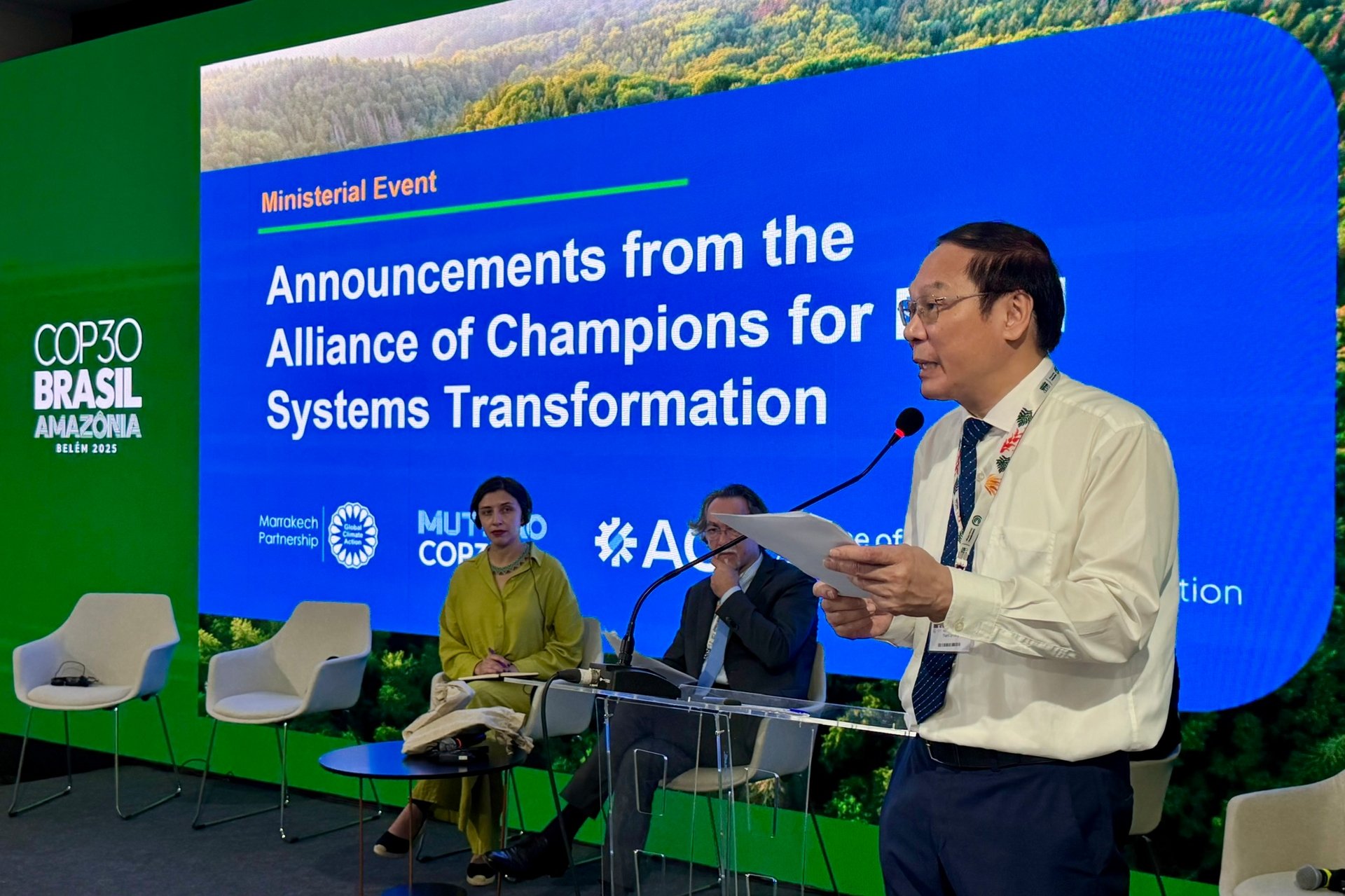
Finally, Viet Nam advanced Article 6 implementation by accelerating domestic carbon market development and international cooperation, positioning itself as a proactive and reliable partner in emerging carbon market mechanisms.
Implications and Recommendations for Viet Nam
The GST findings and MWP outcomes underline the need for Viet Nam to develop an ambitious and credible Nationally Determined Contribution (NDC) for the 2026-2035 period. This requires not only higher emissions reduction targets but also clearer sectoral pathways, particularly in energy, transport, agriculture, and industrial processes. Viet Nam’s Net Zero 2050 commitment must be translated into intermediate milestones that reflect both national capabilities and international expectations. A more detailed and evidence-based NDC will also enhance Viet Nam’s ability to mobilise international finance and technology, especially given the strong emphasis on implementation at COP30.
The elevation of the JTWP into a permanent global mechanism presents Viet Nam with an opportunity to integrate social equity into its climate strategy more deeply. As the country gradually transitions away from fossil fuels and restructures energy-intensive industries, it wants to ensure that workers and communities dependent on these sectors are not adversely affected. Tools for this may include developing just transition roadmaps for coal-fired power, strengthening social protection systems, expanding vocational training, and promoting new green job opportunities. Incorporating these elements into national planning, such as the NDC3.0, power development strategies, and labour market policies, will help Viet Nam safeguard social stability while advancing climate ambition.
COP30 also underscored the growing importance of transparency and institutional capacity. As the GST implementation phase begins, strong data systems and monitoring capabilities become essential. Viet Nam will further strengthen its national greenhouse gas inventory system, improve measurement, reporting, and verification (MRV) practices, to prepare high-quality Biennial Transparency Reports. Transparent, accurate, and timely data will not only support domestic planning but also improve Viet Nam’s negotiating position in global forums and increase its ability to access international support. Participation in the UAE-Belém Dialogue offers Viet Nam a strategic platform to secure financial and technical assistance tailored to its national needs.
The operationalisation of Article 6 provides Viet Nam with significant opportunities to attract investment through carbon crediting and international cooperation. To seize these opportunities, Viet Nam must complete its domestic carbon market framework, including registry systems, MRV protocols, and authorisation procedures for ITMOs. Careful management is required to ensure that the export of carbon credits does not undermine national mitigation goals. Sectors with strong potential, such as renewable energy, afforestation, and low-emission agriculture, could benefit greatly from Article 6 partnerships with countries seeking high-quality credits.
Finally, COP30 highlighted the importance of climate finance as the foundation for achieving global mitigation and adaptation goals. Viet Nam should position itself to benefit from new financing commitments under the Baku-to-Belém roadmap and other international initiatives. Strengthening cooperation through mechanisms such as the Just Energy Transition Partnership, the Green Climate Fund, and bilateral agreements will be crucial for funding renewable energy expansion, climate-resilient agriculture, and adaptation projects, particularly in vulnerable regions like the Mekong Delta. Attracting private investment through clear policies and stable regulatory environments will also be essential.
Conclusion
COP30 represents a pivotal moment in global climate governance. With heightened focus on implementation, equity, and cooperation, the conference’s outcomes lay the groundwork for more coordinated and people-centred climate action in the years to come. For Viet Nam, which faces both significant risks and emerging opportunities, the message from Belém is clear: the next decade must be defined by bold but realistic commitments, strengthened institutions, and a transition strategy that prioritises both environmental sustainability and social equity. If Viet Nam can effectively integrate the lessons and mechanisms of COP30 into its national policy framework, it will not only enhance its resilience to climate impacts but also position itself as an active contributor to the global green transition.