
How circular waste management can contribute to climate mitigation in tourism destinations
Tourism is an important driver of local economic development; however, it also increases resource consumption and municipal waste generation. Da Lat is testing circular waste management approaches in tourism, from composting and waste segregation at source to material recovery, and practical solutions that can support tourism businesses and local stakeholders in using resources more efficiently, reducing waste, and contributing to climate action.
In Da Lat, tourism businesses are taking actions to improve waste management. At Terracotta Da Lat Hotel & Resort, the commitment to “Live Green – Think Green – Develop Green” has been part of the business’s approach since its establishment. Located alongside the pine forests of Tuyen Lam Lake, the hotel has long sought to integrate tourism with nature conservation and social responsibility. In 2020, Terracotta Da Lat was recognised as an ASEAN Green Hotel, reinforcing its commitment to more sustainable tourism.
However, translating green tourism principles into practical integrated waste management measures can be challenging. Following the COVID-19 pandemic and the introduction of new waste management requirements, the hotel identified gaps in implementing revised standard operating procedures (SOPs), introducing waste segregation at source, and improving waste collection and treatment.
Through the ASEAN Municipal Solid Waste Management Enhancement (AMUSE) project, Terracotta Hotel received technical support to address these gaps. Mr. Dang Tan Duoc, the Deputy Executive Manager, worked closely with the AMUSE team to pilot composting at the resort and adapt the project’s waste management guidelines and SOPs to the hotel’s daily operations. “By fully integrating sustainable waste-management aspects into our SOPs, the sustainability of the pilot models can be retained and amplified.” – Duoc shared.
Translating circularity into practice
Terracotta is one example of local stakeholders in Da Lat piloting measures to improve municipal solid waste management and promote more sustainable resource use. The city’s waste stream is predominantly organic, with plastics also accounting for a significant share. This creates an opportunity to move beyond simply collecting and disposing of waste towards waste prevention, waste segregation at source and resource recovery.
The AMUSE project tested different approaches with households, schools and farms, including waste segregation at source and composting. Nine composting models were established with 3 schools, 4 farms, 38 households and a 4-star hotel complex, giving local stakeholders hands-on experience in treating organic waste close to where it is generated. By sorting organic waste at source and treating it appropriately, valuable materials can be recovered and put to productive use, while reducing the amount of mixed waste requiring disposal.
Across six pilot schools, eight “Green House” recyclable waste collection stations were provided. More than 1,500 students and teachers participated in 30 awareness-raising, training and communication activities, embedding practical waste separation and recycling practices into daily school activities.
At Cao Nguyen Hoa Da Lat amusement park, a Material Recovery Facility (MRF) was established to recover and recycle valuable materials. The initiative also created an additional income opportunity for ethnic minority women working at the site through the collection and sale of recyclable materials.
These practical local actions demonstrate how better resource management can contribute to wider environmental and climate goals.
Tourism businesses as climate actors
Tourism businesses play an important role in making tourism more resource-efficient and climate-friendly. Hotels, restaurants and other tourism facilities make daily choices about what they buy, how they use resources and what happens to their waste.
In Da Lat, local tourism businesses shared practical measures such as reducing single-use products, waste segregation at source, and treating food waste through composting and bio-based cleaning products. These simple changes can help businesses use fewer materials, generate less waste, and make better use of the resources they already have.
Waste is linked to greenhouse gas (GHG) emissions throughout its lifecycle, from the production and consumption of materials to collection, treatment, and disposal. Preventing waste, reducing the use of virgin materials, and recovering resources can therefore contribute to climate mitigation while supporting more circular and resource-efficient economies.
However, individual efforts can only go so far. To make these practices part of business operations , tourism operators also need reliable waste collection and treatment services, markets for recovered materials, the appropriate incentives, and effective cooperation mechanisms with local authorities and other partners.
From local pilots to climate action
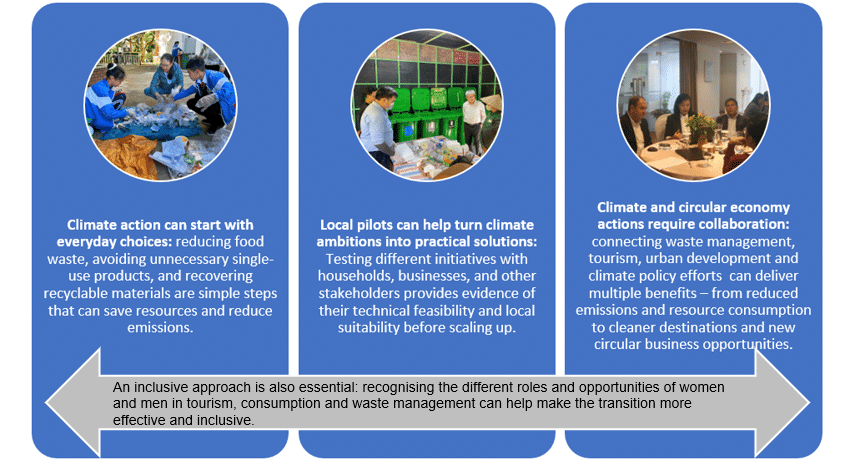
Da Lat’s experience offers three practical lessons that other tourism destinations can build on.
Towards low-carbon tourism destinations
The experience in Da Lat shows that climate action does not always require large-scale infrastructure. It can begin with practical changes in how resources are used, waste is prevented, and materials are kept in circulation.
For Viet Nam and other rapidly growing tourism destinations in ASEAN, integrating circular waste management into tourism development can therefore become part of a broader pathway towards climate mitigation, resource efficiency and more sustainable local economies. Giving waste a second life goes beyond keeping destinations clean – it can also help make tourism more climate-friendly and future-ready.
Learn more about the AMUSE project on our website: ASEAN Municipal Solid Waste Management Enhancement | GIZ