In mid-July 2026, the Ho Chi Minh City People’s Committee issued two closely linked decisions that together form the city’s climate policy architecture for the next decade. Decision No. 4355/QĐ-UBND, dated 15 July, establishes a monitoring and evaluation system for climate adaptation. Decision No. 4393/QĐ-UBND, dated 17 July, approves the Action Plan for Climate Change Response through 2030 with a Vision towards 2050. The action plan supersedes three earlier climate plans: the city’s own 2021 plan and those of Binh Duong and Ba Ria-Vung Tau provinces, which were absorbed into Ho Chi Minh City following an administrative merger, consolidating their tasks into a single framework for the enlarged city. The pairing is notable: the action plan sets the agenda, and the monitoring system defines how progress related to adaptation activities will be measured.
Decision 4393 – What the Plan Sets Out to Do
The plan under Decision 4393 frames two major parallel tracks. The first is adaptation: strengthening resilience against the climate hazards the city already faces such as drought, heatwaves, heavy rainfall, storm surges and sea-level rise, while protecting food security, social welfare and urban ecosystems. The second is mitigation: reducing greenhouse gas emissions and steering the city’s economy toward a low-carbon development path aligned with Viet Nam’s international climate commitments.
Six sectors carry the core implementation responsibilities, each with distinct priorities:
- Agriculture and Environment: Assess climate and sea-level rise impacts on agriculture; manage and restore forests; improve disaster forecasting; apply emission-reducing technologies in waste and wastewater treatment; strengthen GHG management
- Industry and Energy: Transition to clean industrial technologies; manage GHG emissions from manufacturing; promote energy efficiency and renewable energy; ensure energy security
- Construction and Urban Planning: Assess climate impacts on new urban developments; upgrade drainage and flood control systems; ensure water supply security; reduce emissions from construction materials and building activities
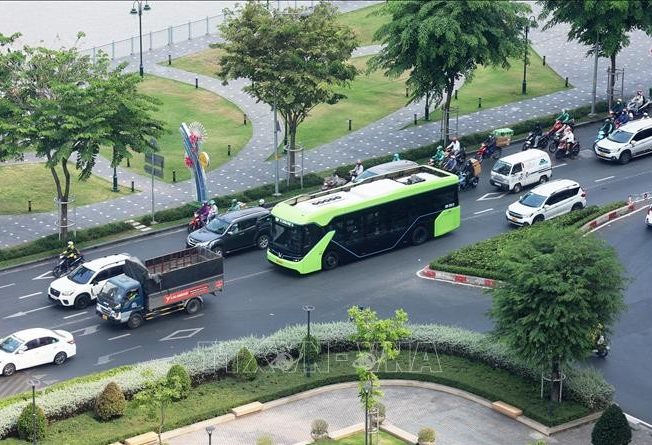
- Transport: Develop climate-resilient transport infrastructure; upgrade roads in flood-prone areas; promote clean energy vehicles and technologies; manage and reduce GHG emissions from the transport sector
- Culture and Tourism: Assess climate impacts on cultural and historical heritage sites; promote green lifestyles and community awareness; develop ecotourism and sustainable tourism
- Healthcare: Build capacity among health workers and communities; strengthen the healthcare system’s climate resilience, prioritising grassroots facilities; adopt energy-efficient medical equipment and source-based medical waste sorting
Decision 4355 gives Ho Chi Minh City its monitoring and evaluation system for climate adaptation. The decision implements, at the city level, a national framework the Prime Minister had already established under Decision No. 148/QĐ-TTg (28 January 2022), which set out how climate adaptation should be monitored and evaluated across Viet Nam. This is worth noting because the gap between climate plans and measurable outcomes is where such frameworks are most often tested.
The monitoring system assigns specific indicators to each sector. For water resources, metrics track water security and wastewater treatment capacity; for construction, indicators measure flood-resistant infrastructure and climate-proofed development; for transport, the length of upgraded climate-resilient road and transit infrastructure. Investment flows such as public budget, ODA and other financing are also tracked, as are science and technology applications and community awareness activities.
Scope and Next Steps
The plan integrates the climate tasks of the three formerly separate administrative areas now merged into the city and is more explicit about the NDC connection: industrial and transport emissions reductions are framed directly as contributions to Viet Nam’s national climate targets. (Appendix I, items 19, 20) The scientific research agenda attached to the plan is also substantive: fourteen research tasks are listed, ranging from AI-powered extreme weather warning systems and GIS-based tidal flood monitoring to studies on how to incentivise businesses to participate in the carbon market (Appendix III, items 12, 5, 10).
On implementation, the plan assigns coordination responsibility to the Department of Agriculture and Environment, which will oversee progress reporting and annual performance reviews across all sectors. Financing will draw on a combination of city budget, state investment capital, ODA and other legally mobilised sources, with individual agencies responsible for identifying and proposing funding through annual budget cycles.
Meanwhile, the adaptation monitoring framework provides a structured basis for tracking outcomes over time, with year-on-year comparisons built into the reporting requirements from the second cycle onward. Taken together, the action plan and its monitoring system represent Ho Chi Minh City’s most consolidated framework to date for coordinating climate response across sectors and administrative boundaries.
Source:
- https://vneconomy.vn/tpho-chi-minh-luong-hoa-toan-bo-hoat-dong-thich-ung-voi-bien-doi-khi-hau.htm
- https://luatvietnam.vn/tai-nguyen/quyet-dinh-4393-qd-ubnd-tp-ho-chi-minh-2026-ke-hoach-hanh-dong-ung-pho-bien-doi-khi-hau-440855-d2.html
- Thành phố Hồ Chí Minh triển khai Kế hoạch hành động ứng phó với biến đổi khí hậu đến năm 2030, tầm nhìn đến 2050 – Trang thông tin Sở Nông nghiệp và Môi trường
- https://sawaco.com.vn/post-detail/ban-hanh-ke-hoach-thuc-hien-qd-so-148qdttg-ngay-28112022-cua-thu-tuong-chinh-phu-ve-he-thong-giam-sat-va-danh-gia-hoat-dong-thich-ung-voi-bien-doi-khi-hau-cap-quoc-gia-tai-tphcm-260722164803.html